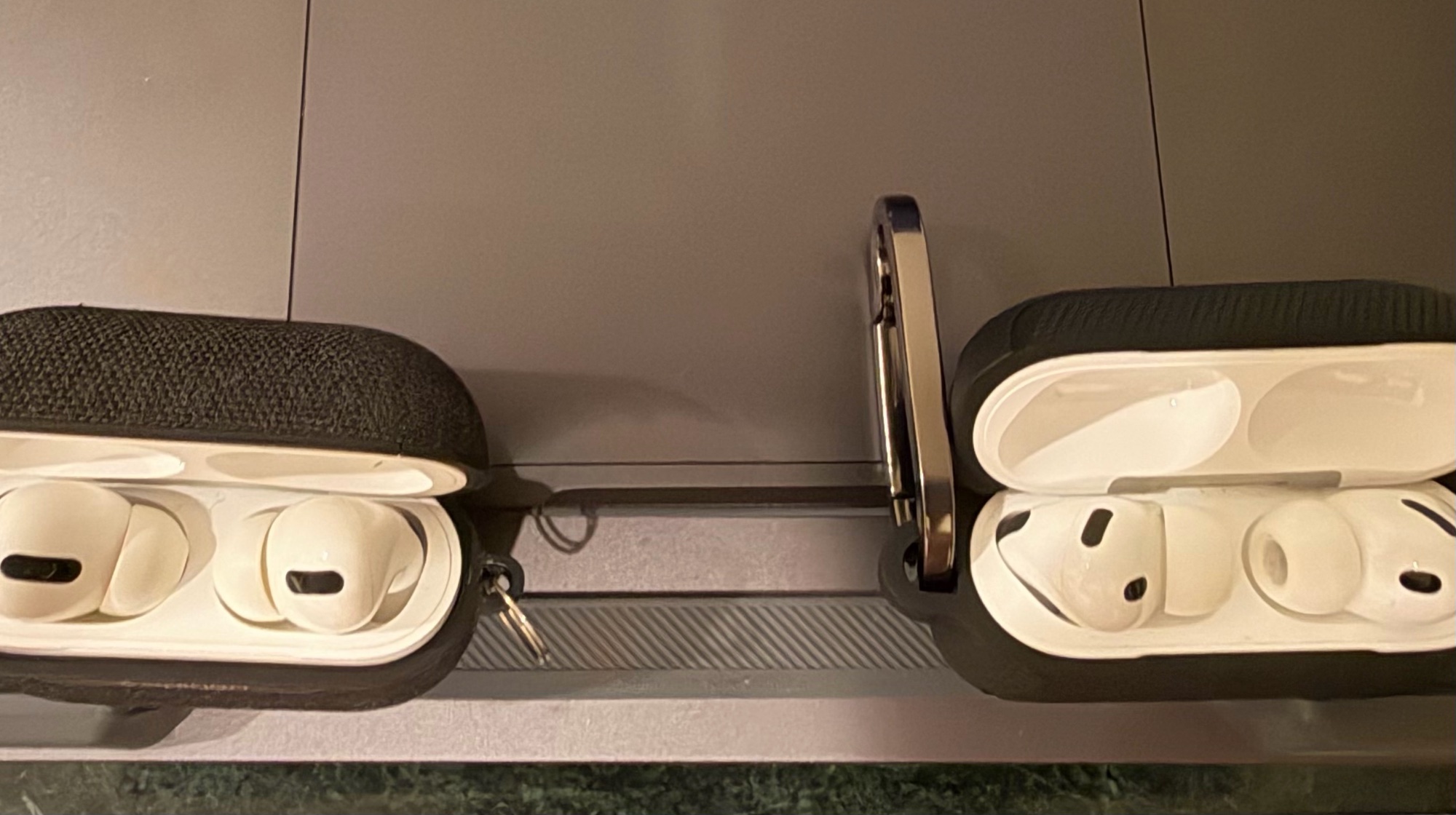
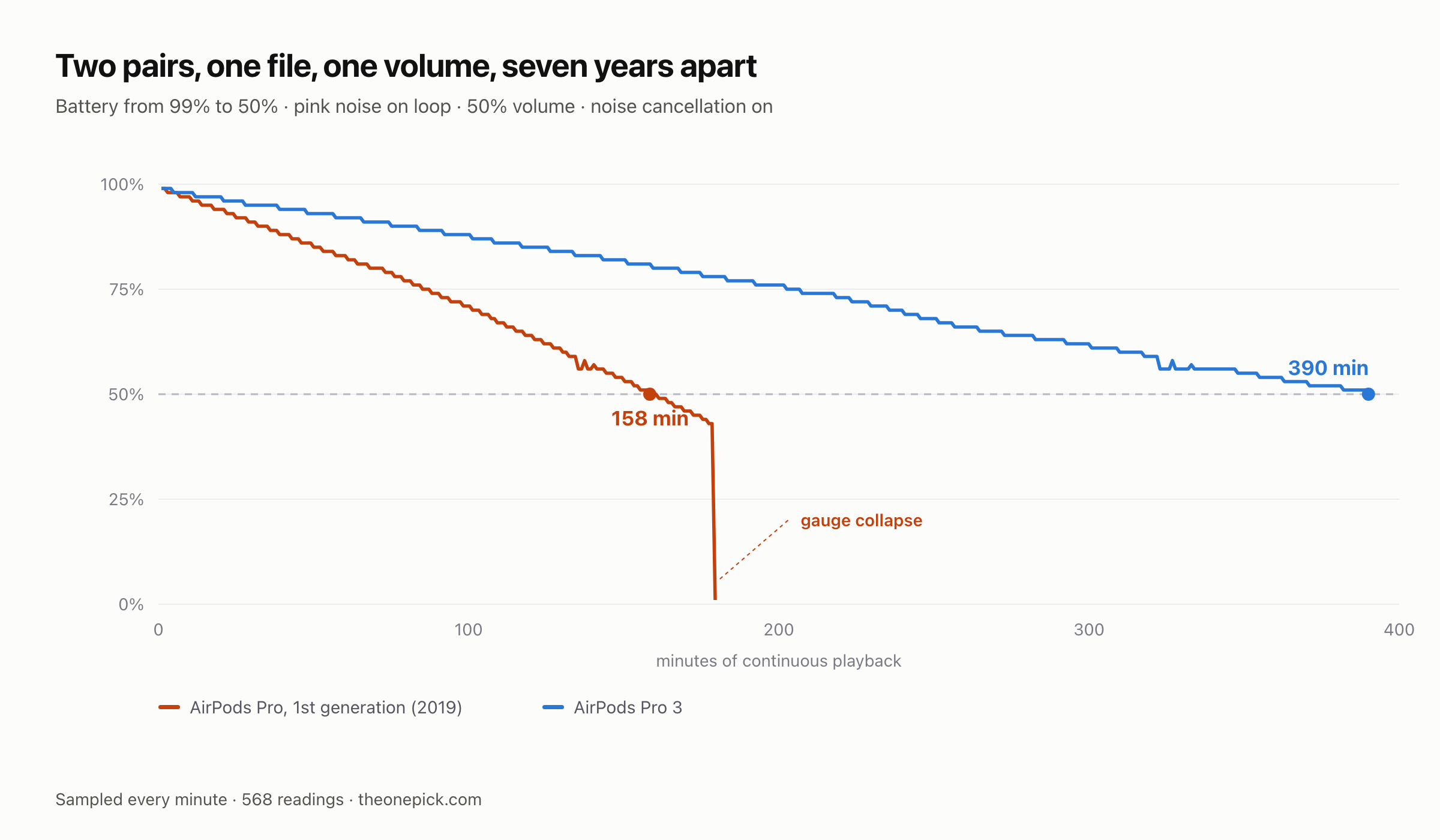
We played the same file at the same volume through a seven-year-old pair of AirPods Pro and a current pair, logging both batteries once a minute for nine and a half hours. From 99% to 50%, the old pair lasted 158 minutes and the new pair lasted 390. That is 2.46 times longer.
The ratio is the easy part. The interesting part is what the old pair did at the end, and what that means for the number on your screen.
How we ran it
Apple publishes its own test conditions for AirPods battery life: volume at 50%, noise cancellation on. We used the same two settings so the comparison sits alongside Apple’s own figures rather than against them.
| Audio | The same 120-second pink noise file, looped, for both runs |
| Volume | 50%, fixed |
| Mode | Noise cancellation on, ear detection off |
| Logging | Left, right and case battery every minute — 568 readings |
| Stop | When the lower of the two buds reached 50% |
| Total runtime | 569.6 minutes across both runs |
Pink noise rather than music, because music has quiet passages and ours would not have been the same quiet passages in both runs. A single looped file removes that variable entirely.
The curves
Both drain in an almost straight line down to 50%. The old pair simply does it more than twice as fast.
| Down to | 1st generation | Pro 3 | Ratio |
|---|---|---|---|
| 90% | 32.1 min | 75.2 min | 2.34× |
| 80% | 68.2 min | 159.5 min | 2.34× |
| 70% | 101.3 min | 235.7 min | 2.33× |
| 60% | 130.4 min | 309.9 min | 2.38× |
| 50% | 158.4 min | 390.1 min | 2.46× |
The ratio holds between 2.33 and 2.46 the whole way down. That consistency is the strongest thing in this measurement. A gap that appeared only in one band would suggest something went wrong in one run; a gap that stays the same across five bands is a difference in drain rate, not an accident of where we happened to stop.
In drain terms: 0.309% per minute for the old pair, 0.126% for the new one. The Pro 3 uses 41% as much battery per minute of playback.
Then the old pair fell off a cliff
We had planned to run the first-generation pair down to 20%. At 179.5 minutes the right bud went from 45% to 1% in a single minute, while the left was still reading 42%.
177.5 min    left 43%    right 45%
178.5 min    left 43%    right 45%
179.5 min    left 42%    right  1%   ← collapse
We checked four more times. It stayed at 1%. This was not a misread.
An aged cell sags under load, and at some point the gauge recalibrates all at once against a voltage that no longer matches what it had been reporting. The 45% was never 45%. The pair passed 40%, 30% and 20% at the same instant, which is why there is no meaningful reading below 50% on this unit, and why we compare only the 99% to 50% band.
If you own old AirPods and they seem to die without warning, this is what that looks like from the inside. The battery is not dropping suddenly. The number was wrong before it dropped.
What this does not tell you
Apple’s published figures are for a full charge to empty: 4.5 hours for the first-generation AirPods Pro, 8 hours for the Pro 3, both with noise cancellation on. We measured half a charge, not a full one, and we are not going to double our numbers to meet Apple’s.
The collapse is exactly why. The second half of a battery is not a mirror of the first, especially on a worn one, so we cannot tell you whether either pair met its claim. What we can tell you is how they compare to each other over the half we did measure, under conditions we controlled.
Where our numbers are weak
- Wear and design are mixed together. This is a percentage comparison, and 50% of a worn 2019 battery is not the same amount of energy as 50% of a new one. The 2.46× contains both seven years of degradation and whatever Apple improved between the generations. Our data cannot separate them.
- One run contaminated. At 70.7 minutes the iPhone switched output to its own speaker for about a minute, so the old pair was not playing for roughly 0.6% of its run. That makes the old pair’s result slightly too long, which means the true ratio is a little above 2.46×, not below it.
- Noise cancellation with the buds out of the ears. The cancellation was running against an open room rather than a sealed ear canal. Both pairs were in the same state, so the comparison holds, but the absolute minutes would differ if worn.
- One run each. We did not repeat either measurement, so we cannot state a run-to-run spread the way we do for our benchmark work.
- One pair of each. We do not know how this 2019 unit was charged or stored over seven years, and AirPods do not report battery health the way a Mac or an iPhone does. That is the whole reason a measurement like this has to be made rather than looked up.
If you want to check your own
You do not need a script. Charge them, turn off ear detection so they keep playing on the desk, set the volume to 50%, turn noise cancellation on, and put a long track on repeat. Note the time and the percentage every half hour.
Watch the two buds separately. Ours diverged by 3 points and then by 41 in the space of a minute. A pair that is ageing badly will usually show you one bud before the other, and that is the earliest warning you will get — because the battery health screen you would check on any other Apple device does not exist here.
Measured 19 September 2026, 12:42 to 23:41. AirPods Pro 1st generation (2019) and AirPods Pro 3, logged from macOS 27 at one-minute intervals, 568 readings, 569.6 minutes of total runtime. The first-generation run started at 12:42 and ran 179.5 minutes with one output interruption; the Pro 3 run started at 17:10 and ran 390.1 minutes with none.